
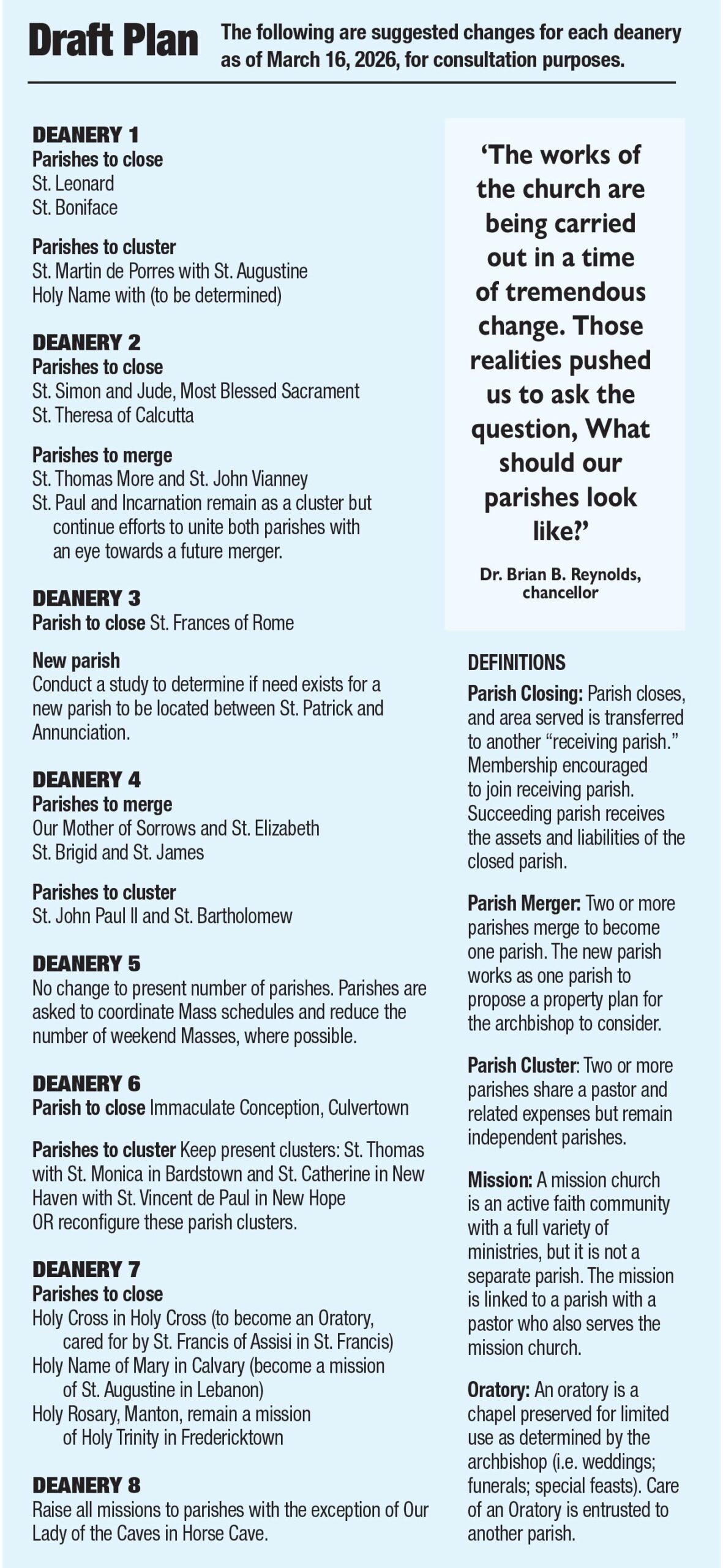
For the third phase of the Archdiocese of Louisville’s Parish Planning Process, which began last May, the archdiocese has issued a draft plan outlining suggestions made by parishes in the second phase, including parish closings, mergers, clusters and new construction.
Next, pastors and pastoral leaders in each deanery will gather to review the suggestions and offer feedback, according to instructions for phase three of the process. The feedback may:
- Affirm the plan as drafted by the planning committee.
- Suggest adjustments to the plan.
- Suggest new initiatives.
- Propose implementation timelines.
Additional consultation will be held with other groups, such as retired clergy and school leaders.
“This consultation will shape the plan in some important ways,” said Dr. Brian B. Reynolds, chancellor and chief administrative officer of the archdiocese.
The suggestions in the plan “came from the local deaneries,” he noted. “There were dozens and dozens of suggestions. The planning committee looked at all the recommendations and data and discerned how this would impact the diocese.”
The committee consists of a dozen men and women, including Archbishop Shelton J. Fabre, archdiocesan leaders, parishioners and parish staff, clergy and religious.
“The works of the church are being carried out in a time of tremendous change. Those realities pushed us to ask the question, What should our parishes look like?”
— Dr. Brian B. Reynolds, chancellor
The Archdiocese of Louisville initiated the year-and-a-half-long parish planning process in May to consider “the evolving needs within our local church.”
Parishes were provided a case statement and statistics, highlighting four organizational issues to consider:
- The available number of priests to serve parishes and parishioners
- The number of aging and underutilized facilities and properties
- Changing demographics
- Stewardship of resources
“More than 40 percent of our pastors serve more than one parish,” noted Reynolds in an interview about the draft plan. That means sometimes “parishioners can’t even see their priest after Mass because he has to get to another church.”
“The works of the church are being carried out in a time of tremendous change,” he said. “Those realities pushed us to ask the question, ‘What should our parishes look like?’ ”
With that in mind, the archdiocese asked parishes to consult with parishioners and compile qualitative reports indicating their strengths, the challenges they face and what is unique to their community. Parishes were also asked to provide quantitative reports, examining everything from participation in Mass and other sacraments to the state of their facilities and finances.
For the second phase, which began in October, every parish received a binder containing summarized reports on each of the parishes in their deanery, along with maps and comparative charts of the data provided by the parishes.
Each parish was asked to consider the following question, said Reynolds:
“In light of the parish reports, changes in the number of available priests, the data on demographics, the information on facilities and finances, what possible changes would you recommend?”
In January, each parish submitted recommendations, suggesting changes to parish structures and pastoral assignments within their deanery.
The planning committee took all these things into account when drafting the plan, Reynolds said.
The desire to have thriving parishes is “challenged by fewer priests and more facilities than we can support,” Reynolds said, noting that three parishes closed in 2025 for these reasons. “Nobody starts by wanting fewer churches. But the reality of our situation is shaping us, and we have to respond.”
Once the feedback is received in June, phase four — Preparation of the Final Plan — will begin. Reynolds said a final plan will likely be announced in October.
The last time the archdiocese conducted a comprehensive parish study was in 2005.
Those who have questions about the draft plan or the Parish Planning Process are encouraged to contact their pastors.

This is heartbreaking.
This is so heartbreaking.