
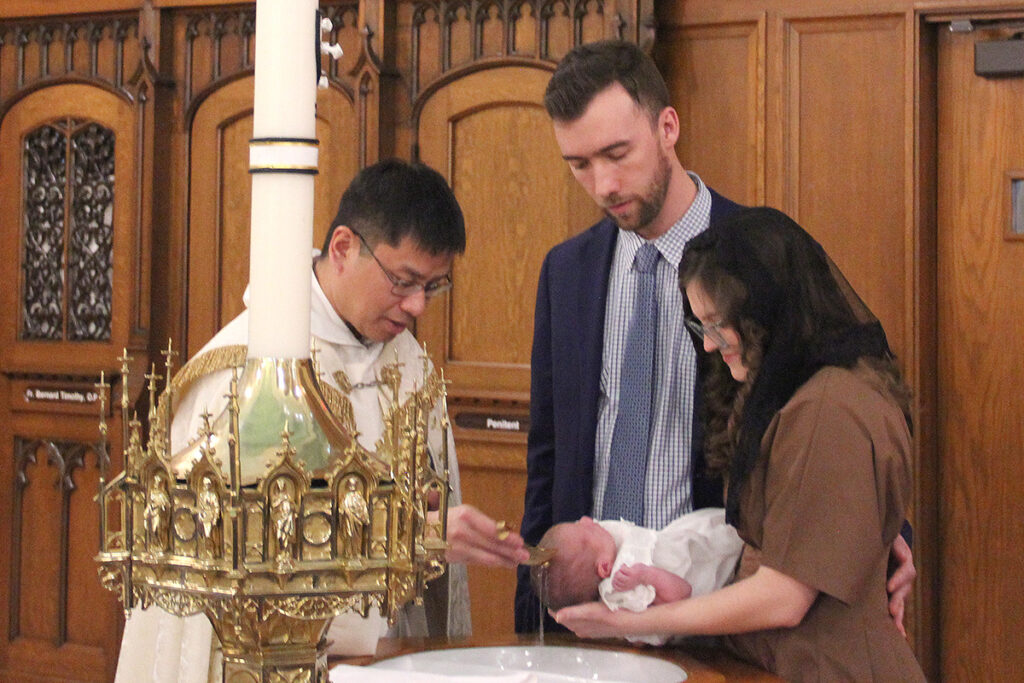
The Archdiocese of Louisville has issued a new set of guidelines to help parishes and families navigate the preparation and celebration of the sacraments of baptism, penance, first Holy Communion and confirmation.
“The Sacramental Guidelines: Addressing Key Moments in the Christian Journey” is available for download in English and Spanish at www.archlou.org/sacramental-guidelines/. The document went into effect on Ash Wednesday, Feb. 18.
“This is a usable resource. A pastor, catechetical leader, director of worship, average person in the pew — anyone can access it. It’s a resource for what the church is asking us to do.”
— Archbishop Shelton J. Fabre
The new guidelines, which replace those issued in 2007, are meant to bring unity and uniformity to the celebration of sacraments around the archdiocese and to “enhance the encounter with Christ” in the sacraments, said Archbishop Shelton J. Fabre in an interview.
“This is a usable resource. A pastor, catechetical leader, director of worship, average person in the pew — anyone can access it. It’s a resource for what the church is asking us to do,” he said.
The document asks that parishes conform to the guidelines as a way to bring unity across the archdiocese. For example, the guidelines ask that parishes set confirmation for eighth grade, something that has varied at times from parish to parish.
“Say you have a parish that does confirmation in eighth grade, and a family moves schools to one that does it in sixth grade,” noted Archbishop Fabre. “Now you have an eighth-grader being confirmed with sixth-graders. With a united practice, it makes this less likely.”
Tradition v. tradition
The guidelines begin with an overview and point out the importance of proper record-keeping and appropriate liturgical practices for the sacraments. For instance, they note the importance of distinguishing between performance and participation during the liturgy.
Art Turner, the director of the archdiocese’s Office of Faith Formation, said parish traditions, such as “having the children sing (or perform) a song after their first Communion, that’s an inappropriate thing to do.”
He said practices like this are traditions “with a little ‘t’ ” — parish-based traditions not rooted in the celebration of the sacrament. He said these traditions can detract from the sacramental celebration and are sometimes unfair. He noted an instance at a first Holy Communion celebration when “school children had learned and practiced a song while the religious education kids didn’t know it and were embarrassed.”
Dr. F. DeKarlos Blackmon, vice chancellor for pastoral services, said in a similar way, a candidate for a sacrament shouldn’t have any other responsibilities during the liturgy.
“If someone is going to be the lector, it shouldn’t be the candidate.” They should be focused on receiving the sacrament, not be preoccupied with their role as lector, he said.
Two pathways
Shifting to the sacraments themselves, the guidelines first point out that there are two paths toward full initiation. Someone baptized as an infant follows the most common path — first Holy Communion and penance in second grade and Confirmation in eighth grade.
Those who are not baptized before age 7 follow a different path. From age 7 and older, people are considered of “catechetical age.” The church believes the individual has the ability to choose to be baptized themselves, and they enter the church through the catechumenate process known as OCIA, the Order of Christian Initiation of Adults. (Despite its name, the process provides age-appropriate formation.)
Through this process, the catechumen receives the sacraments of initiation at the Easter Vigil. Thus, a 7-year-old would be confirmed well ahead of their classmates, which can cause some social concerns for families who want their children to receive the sacraments with their friends, the guidelines note.
“In the current reality of the Church, parents are delaying the baptism of their children for many reasons. When these parents place their child in a Catholic school or a parish religious education program, they may not think about the baptism of their child until second grade, when the focus of instruction turns to First Communion,” the guidelines note. “Some families may not even think about Baptism or First Communion until there is talk about Confirmation, when the young person wants to be included in the event with all of his or her friends.”
Dr. Karen Shadle, director of the Office of Worship, said, “As a faith community, these are not merely social rituals. That is important,” she said, “but it is more than that.”
The guidelines explain, “The sacraments of initiation invite us to enter into a deep and personal relationship with Jesus Christ and his Church.”
Shadle noted that children who receive sacraments through OCIA can still attend normal catechetical classes with their classmates, and they can participate in their class’s sacramental celebration in other ways, such as serving as a lector for the Mass.
She encourages families to think about baptism before children reach age 7. She said she hopes schools and parishes ask about baptism and provide guidance to new families when enrolling them in preschool and kindergarten.
“We cannot expect parents to know this coming in,” she said.
The sacraments
The new guidelines go on to address each of the sacraments. They explain the theology behind them and list the steps involved in preparing for and celebrating them. Each section ends with a list of frequently asked questions.
Most of the guidelines aren’t new, but it’s important to address them, said Blackmon, or “we can find ourselves in a situation where we are doing things by rote.”
For instance, the guidelines point out that in order to protect the penitent’s privacy, photos and videos should not depict an individual at confession.
New to the guidelines is a meeting with the archbishop. Previous bishops required confirmation candidates to send a letter about their desire to be confirmed. Archbishop Fabre has established a new practice of having the celebrant (either the archbishop or his designate) meet with the confirmation class for about 30 minutes prior to the Confirmation Mass.
“It’s better for the candidates for confirmation to encounter the celebrant rather than write a letter to someone they never met,” said Archbishop Fabre. “It’s a moment of encounter. It’s an opportunity for the archbishop or the celebrant to explain more to the children what they are experiencing and to encounter them.”
Archbishop Fabre said the new guidelines don’t mean that something has been wrong in the past, rather they are meant to “enhance people’s experience.”
Turner, the director of faith formation, said he encourages people to read the guidelines.
“The worst thing that can happen is that it sits on a shelf,” he said. “Or that you flip straight to the rules without reading the whole thing,” which explains Church teaching.
