
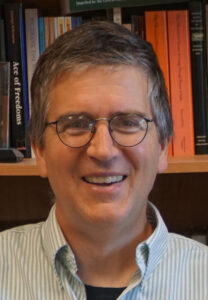
There is some interesting new work out of the Vatican Observatory. Dennis Danielson of the University of British Columbia and I have an exciting book just published by Oxford University Press — “A Universe of Earths: Our Planet and Other Worlds, from Copernicus to NASA.”
Consider peopleʼs beliefs about other worlds like Earth. Do they exist? Are they so common that things like UAPs (that is, UFOs) should be attributed to extraterrestrials?
Such beliefs have religious implications. People have long argued that a universe full of other earths, inhabited by other intelligent beings, would render Christianity, in the words of Thomas Paine in “The Age of Reason,” “little and ridiculous” and would “scatter it in the mind like feathers in the air.”
Why? Because, Paine said, either God would have to redeem the inhabitants of one earth after another, or our Earth would be Godʼs unique point of attention among myriads of others.
There have been Catholic counter-arguments, of course, but criticisms like Paineʼs seem weighty because they appear to involve science.
Danielson and I argue that they do not.
We show that when Giordano Bruno (famously burned at the stake in Rome) proposed that the universe was full of other earths orbiting other suns, the available scientific evidence clearly said otherwise.
We point to the great astronomer Johannes Kepler, who argued against Bruno — scientifically — that our Sun and its planetary system was unique. We know now that Keplerʼs arguments were flawed, but no one then would have known that. His arguments were based on measurements that seemed solid (until the nature of light became better understood). Brunoʼs arguments, by contrast, were speculative.
We also show that, in the 19th century, science began to reveal the diversity present within the universe. Both planets and stars were discovered to be diverse. Venus, for example, might be thought to be Earthʼs twin, being about the same size. Venus is no twin, however; it is an acid-swept, furnace-like hellscape. And whereas some stars are like our Sun, others have the power output of a thousand suns, while still others produce but a fraction of the Sun’s output. Also in the 19th century, science revealed as bogus the ancient idea that life is an ordinary consequence of matter (via “spontaneous generation”), a key idea for a life-filled universe.
If stars and planets are not necessarily suns and earths, and if life is not a necessary consequence of matter, then that should challenge the idea of a universe full of earths. But that challenge has been disregarded, and we now have a modern popular culture steeped in other earths. On one hand, we have Star Wars, Star Trek, and the like, while on the other hand, we have people believing that the Vatican (yes, the Vatican!) is hiding the truth about extraterrestrials and UAPs.
Danielson and I speculate on the “other earths” appeal, connecting it to an ancient tendency to see the Earth as lowly. We argue that the realization that Earth is a planet raised its status, perhaps imagining Earth as just one planet among myriads, was a way to unconsciously preserve the ancient view.
Whatever the reason, science has shown that our Earth is not just another world, but the garden spot of the Solar System, and, given what we see of other planetary systems, likely the garden spot of a much wider area.
If other earths are few and scattered, then they will be too distant to be the source of UFOs, criticisms like Paineʼs wonʼt really apply and Star Trek will be a work of fantasy, not science fiction.
I am grateful to be able to do such interesting research and see it published.
Chris Graney is an astronomer and historian of science with the Vaticanʼs astronomical observatory. He lives in Louisville.
