
Cameroon (OSV News) — A religious sister in Cameroon who was kidnapped just a few months ago by separatists and held hostage for three days in the bush was among those who shared her testimony with Pope Leo XIV April 16 in an emotional peace meeting in Cameroon’s northwest city of Bamenda, a region marred by years of separatist violence.
“We were held hostage for three days and three nights. During those days and nights, we neither slept nor ate,” Sister Carine Tangiri Mangu told the pope.
“What kept our hope alive was the rosary which we prayed continuously for those days,” she added.
“Most Holy Father, this is the situation under which many consecrated women do their work and live their lives within this war zone. Some have undergone more dramatic and more traumatizing experiences, but we continue to rely on the help of God and the intercession of the Blessed Virgin Mary,” she said.
Pope Leo led a historic peace meeting on April 16 in Cameroon’s northwest city of Bamenda, a region marred by years of separatist violence.
The long-running separatist conflict in its English-speaking regions has killed thousands since 2017. The violence pits Anglophone separatists against the Francophone-dominated government, leaving entire communities displaced and children out of school in what humanitarian groups describe as one of the world’s most neglected conflicts.
In his speech in St. Joseph’s Cathedral, Pope Leo loudly and passionately said, “I am here to proclaim peace,” to an enthusiastic reaction in the crowd.
The pope also had strong words of denunciation for those who perpetuate war. “The masters of war pretend not to know that it takes only a moment to destroy, yet often a lifetime is not enough to rebuild,” the pope said. “They turn a blind eye to the fact that billions of dollars are spent on killing and devastation, yet the resources needed for healing, education and restoration are nowhere to be found.”
Pope Leo strongly denounced those who “rob your land of its resources generally invest much of the profit in weapons, thus perpetuating an endless cycle of destabilization and death.”
“The world is being ravaged by a handful of tyrants, yet it is held together by a multitude of supportive brothers and sisters,” he underlined.
During the peace meeting, the pope heard testimonies from local traditional and religious leaders and a family displaced by the violence.
A local chief imam told the pope about how in November armed men invaded a mosque in Sabga, near Bamenda, during the time of prayer and killed three people, injuring nine others.
Mohammed Abubakar of the Buea Central Mosque continued that on Jan. 14, 2025, “Armed men targeted cattle rearers from the Mbororo ethnic community and killed at least 15 people, including 8 children.” The chief imam added that “The Islamic community has suffered in many English speaking towns and villages, and there were Muslim victims in what has come to be known as the Ngabur Massacre, in which 23 civilians were killed in 2020.
“Holy Father, welcome, and please help us to have peace again,” the imam added.
Denis Salo met the pope, along with his wife and three children, telling Pope Leo how “five of my neighbors were killed and one of my close friends was also killed. While we were being targeted by the separatist fighters, government soldiers were also burning down houses.”
“In 2017, I escaped with my family out of Mbiame, abandoning all that I ever owned, including house, farms, and animals, and arrived in Bamenda. My kids had to abandon school. After seeing no better in Bamenda, I proceeded to Douala to look for livelihood and not finding anything better, I returned to Bamenda,” he said. “I now live in a little rented house with my entire family, and working as a gateman in the hospital of Maria Soledad, and at the same time working as gardener in the Parish of the Immaculate Conception, Ngomgham,” Salo said.
The pope affirmed to the afflicted community that “God has never abandoned us! In him, in his peace, we can always begin anew!”
In an emotional address welcoming the Holy Father in the cathedral, Archbishop Andrew Nkea of Bamenda told the pope: “Today your feet are standing on the soil of Bamenda that has drunk the blood of many of our children.”
“The archbishop mentioned the prophecy that exclaims: ‘How beautiful upon the mountains are the feet of the messenger who announces peace!’ (Is 52:7). He welcomed me with these words, and now I would like to respond: how beautiful are your feet as well, dusty from this bloodstained yet fertile land that has been mistreated, yet is rich in vegetation and fruit,” the pope said.
The Rev. Fonki Samuel Forba, moderator emeritus of the Presbyterian Church
in Cameroon, described to the pope how religious leaders of different denominations have “bonded together and founded a Peace Movement through which we have tried to broker peace and dialogue with the government of Cameroon and the Separatist Fighters.”
He said that under the leadership of Archbishop Nkea, they “have visited and spoken with many of the leaders of the separatist movements at home and abroad, and we have tried to engage the local separatist fighters on the ground in dialogue, convincing them that peace is better than war, and that war can never really solve any conflict,” he said.
“Practically all of us gathered here are traumatized and need both psychological and spiritual healing,” the reverend said.
“This Anglophone crisis is one of the forgotten crises on the planet earth, but it was brought to the notice of the Vatican, and the Vatican was even willing to facilitate dialogue between the warring factions,” Reverend Forba said.
Bishop Michael Miabesue Bibi of Buea told OSV News that the Anglophone crisis made it impossible for people to live normally in the conflicted region.
On top of loss of life and education opportunities for children, he said people “experienced abject poverty” as farmers were unable to sell products due to violence.
“There are people whose houses have been destroyed and they have been rendered homeless,” instantly becoming internally displaced, the bishop listed.
Even though pastoral work has been challenging, the bishop said, “we continue to hope in God, as we continue to pray and the situation will be better.”
Pope Leo expressed support for how “religious leaders have come together to establish a Movement for Peace, through which they seek to mediate between the opposing sides.”
He had however a strong condemnation for those who wage war in the name of God.
“But woe to those who manipulate religion and the very name of God for their own military, economic and political gain, dragging that which is sacred into darkness and filth,” Pope Leo said.
“Yes, dear brothers and sisters, you who hunger and thirst for justice, who are poor, merciful, meek, and pure of heart, who have wept — you are the light of the world! (cf. Mt 5:3-14),” he said.
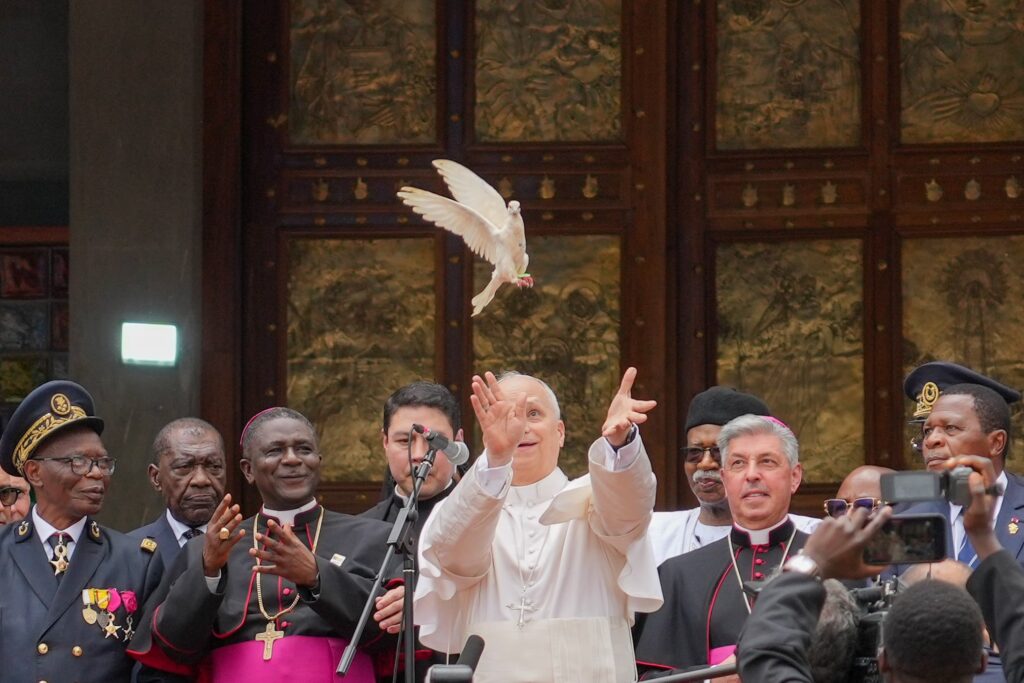
After the ceremony, Pope Leo XIV released doves outside of the cathedral, symbolizing peace. A crowd gathered outside of the cathedral, people sang and cheered enthusiastically.
“Our hearts are full of joy and it sounds unbelievable that the successor of St. Peter is among us in this remote part of Africa,” Archbishop Andrew Nkea of Bamenda told the pope.
