

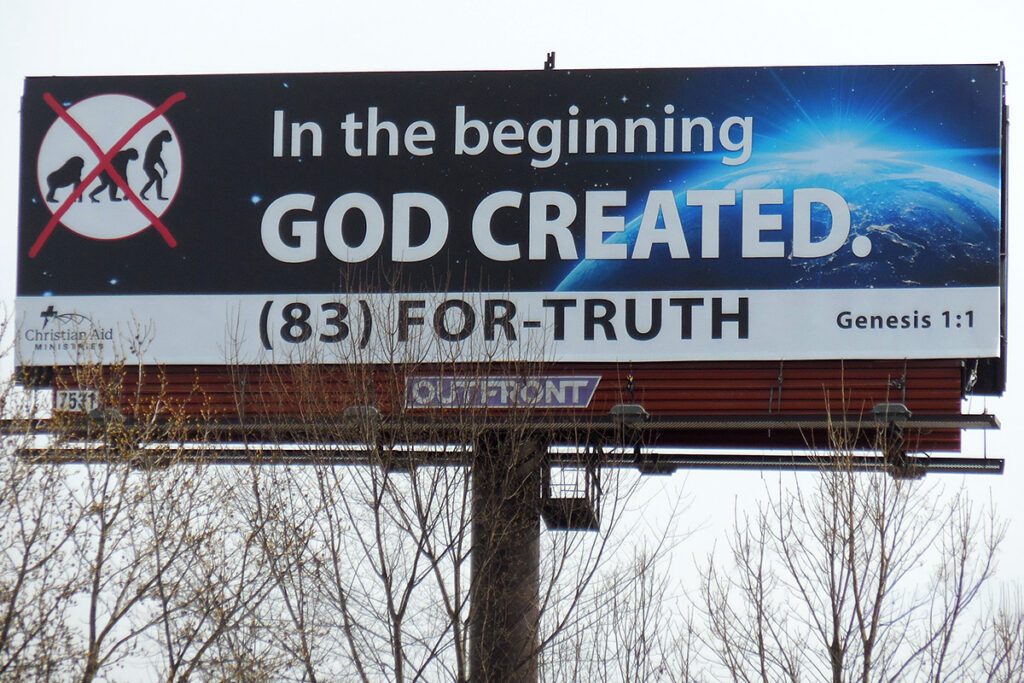
If you drive east along Interstate 64 heading toward downtown Louisville, you cannot miss the creationist billboard recently erected near the 22nd Street exit. It says, “In the beginning, GOD CREATED,” with a big red “X” across one of those stock “Evolution of Man” diagrams that show the silhouettes of an ape, then an ape-man, then a man, each increasingly upright.
At times, I too, am a creationist. Why?
First, something as ever-changing as science can seem inadequate when considering weighty matters like questions about eternal truths. Consider that, only some decades ago, we imagined that the universe would be sort of familiar.
Yet today we understand that most of the universe is not made of the familiar matter and energy that we see daily, but of mysterious “dark matter” and “dark energy.”
Today, we see that other solar systems can be very different from our solar system, containing planets like we never imagined back when the only planets we knew of were those going around our sun.
What science of today will turn out to be wrong tomorrow? Such an unsteady hook on which to hang weighty matters!
Second, science can sometimes be unpleasant, giving us things like the prospect of nuclear Armageddon or (more speculatively) tyrannical robot overlords.
But more to the point of that billboard, Stefanos Geroulanos in his acclaimed and award-winning 2024 book, “The Invention of Prehistory: Empire, Violence, and Our Obsession with Human
Origins,” argues rather forcefully that the study of human origins, at least, is hopelessly entangled with an ugly racist history.
The book characterizes that study as “one of the most ruinous” intellectual endeavors of modernity, and urges that “we would be better off setting aside the search for how (humanity) started.”
Geroulanos argues that ideas about “ape-men” have been used to dehumanize groups of people, allowing the powerful to say: “Once all humans were like this (like ape-men), but we developed. They stayed like that.” And, the powerful could say, since they are basically subhuman ape-men, we can do what we want to them.
That’s certainly enough to make a scientist want to join the Young Earth Creationists and dispense with prehistory altogether.
And third (and on a much more positive note), I just like the language of a newly-created world. I like the hymn “Morning has Broken” — “Morning has broken, like the first morning. Born of the One Light, Eden saw play.” How do you get lyrics like that out of 10-plus billion years of evolving universe?
On the other hand, there are many reasons to believe that the universe is 10-plus billion years old and evolving. One of the simplest is other galaxies, at least one of which (in the constellation Andromeda) is visible to the naked eye.
Even creationists who insist that creation is plainly described in Genesis 1, and happened less than 10,000 years ago, acknowledge the existence of other galaxies. However, those galaxies (including Andromeda) are so distant that we could not see them if the universe were created in a few days, merely thousands of years ago. Their light would not have reached us yet.
And then there’s that “first morning.” Genesis 1 mentions six mornings. However, the sun is not created until the fourth day. No sun, no mornings — not the mornings that we experience, at any rate.
Therefore, at other times, I am no creationist. I see the universe as plainly old and evolving, and I see Genesis as giving no plain description of any “first morning,” nor of creation generally.
And of course, even if the universe is old and evolving, God still created it. Just not in the way the folks behind that billboard had in mind.
Chris Graney is an astronomer and historian of science with the Vaticanʼs astronomical observatory. He lives in Louisville.
Editor’s note: The Catholic Church teaches that God is the creator of all things. Roman Catholic teaching understands the creation accounts in Genesis not as literal history showing “how” the world was created, but as statements of faith describing the relationship God has with humanity and all of creation. Science allows us to explore the “how” while not compromising the truth about “why” God created.
