
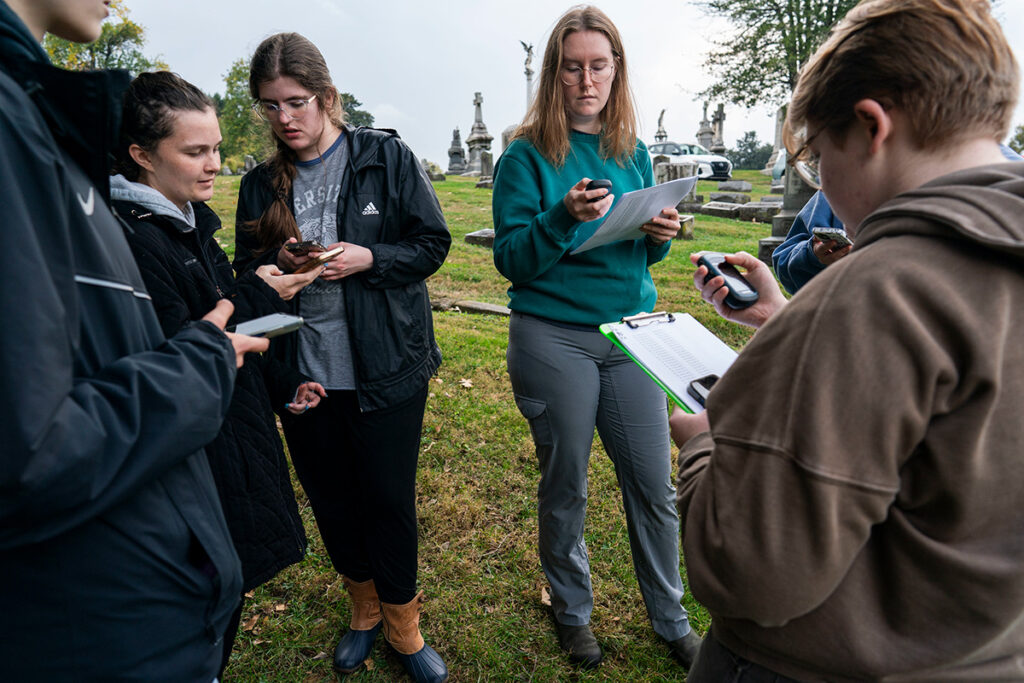
Bellarmine University students studying geographic information systems last fall mapped and marked the graves of Black Catholics buried in the Archdiocese of Louisville’s St. Louis Cemetery.
It was the latest step in an ongoing project led by Deacon Ned Berghausen — who serves at St. Agnes Church — to identify and honor Black Catholics buried in unmarked graves in the cemetery located at 1167 Barret Ave.
“It’s a work of mercy to honor the dead, particularly for a community that has been neglected and not honored,” said Deacon Berghausen in a recent interview.
At first glance, the part of the cemetery where the graves are located looks like an undeveloped field. But 1,589 individuals are buried there.
Among them are veterans of the Civil War and World War I, said Deacon Berghausen. The area of the cemetery is divided into two — section T and section X. In section T, the larger of the two, Bellarmine students placed row markers as they conducted their work, he said.
In 2024, Deacon Berghausen completed a 13-month project to find the names of people buried in the once-segregated section of the cemetery between 1867 and 1937.
Identifying where they were buried — in the midst of the grassy field — remained a challenge.
“It’s a work of mercy to honor the dead, particularly for a community that has been neglected and not honored.”
— Deacon Ned Berghausen
Dr. Michele Biskis, an assistant professor in Bellarmine’s Department of Environmental studies led the student project to delineate rows of graves. A group of six students from Biskis’ geographic information systems class spent the fall 2025 semester working in the classroom and in St. Louis Cemetery, Biskis said.
In the classroom, “We talk about satellites and where you are in the world and how you know that from a mapping point of view,” said Biskis in a recent interview. Serving at the cemetery helped her pupils learn “more about their community and how what they are doing helps the community.
“So, that way, it’s not necessarily just the city on the hill. It’s also like, ‘Hey there’s this whole entire world outside of this campus. Let’s go learn about it and do something about it,’ ” Biskis said.
They located the rows using equipment known as ground penetrating radar, which sends laser beams into the ground, said Biskis. The information collected from below the ground was converted to GPS coordinates, which they used to mark rows of graves.
Among the students who served the dead at the cemetery was Tiffany Couch, a junior studying environmental justice and sustainability.
“To apply our classroom knowledge to a project that is so important and relevant was extremely exciting,” and gave purpose to the content she is learning in the classroom, Couch said in a recent interview.
She noted the project has given her a new perspective on the cemetery and classroom lessons on human dignity.
“I’ve driven past the cemetery so many times and I had never paid any attention to it, so getting to actually go into the cemetery and learn the history gave me a whole new perspective,” she said. “Every time I drive by now, I can think about all the stuff that went down and the families that are buried there and how I kind of had a mark on that whole project.”
Couch said she felt as though she and her classmates played a part in restoring the dignity of individuals buried in the cemetery.
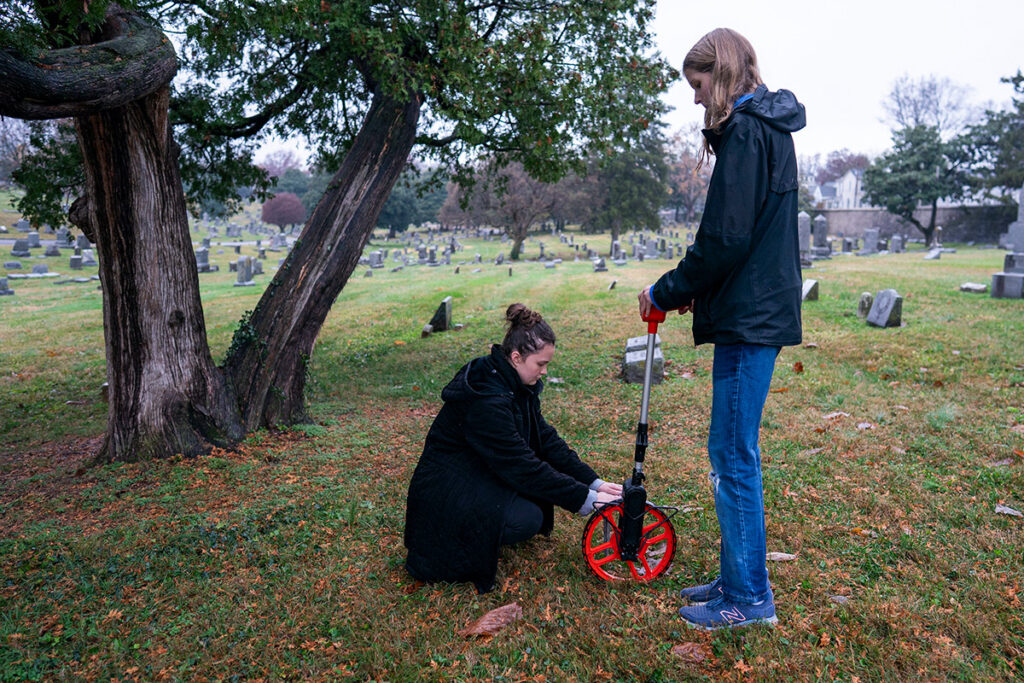
“We’ve talked a lot about the intrinsic dignity that everyone has. We get to bring some of that dignity back to the people who are buried there that previously had been forgotten or had been lost in history, and that’s one of Bellarmine’s core values that’s riveted in Catholicism. It was cool to be able to play that out in the community even though I’m not Catholic.”
They were able to mark 40 rows, making it possible to locate the graves, Deacon Berghausen said.
“If a descendant wanted to find a grave, the cemetery can give a row and grave number. The row marker gives a physical identifier. … A descendant can walk to that spot and find the burial location,” he said.
To see the students’ involvement and their work is gratifying, Deacon Berghausen said.
“To see something physical and tangible feels gratifying,” he said.
Deacon Berghausen said many individuals have assisted behind the scenes to help with the work being done in St. Louis Cemetery — the Sisters of Loretto and the Snowy Owl Foundation, a local non-profit — donated funds for the markers. Members of the Sister Thea Bowman Society for Racial Solidarity and the (Un)Known Project have also contributed to the work of identifying Black Catholics buried in the cemetery, Deacon Berghausen said.
Next, he is partnering with history students at Bellarmine who will take on a project using historical records to write the stories of Black Catholics buried in the cemetery, he said.
“It’s been great to have the students involved. Many people care about this work,” said Deacon Berghausen.
