
By Kate Scanlon, OSV News
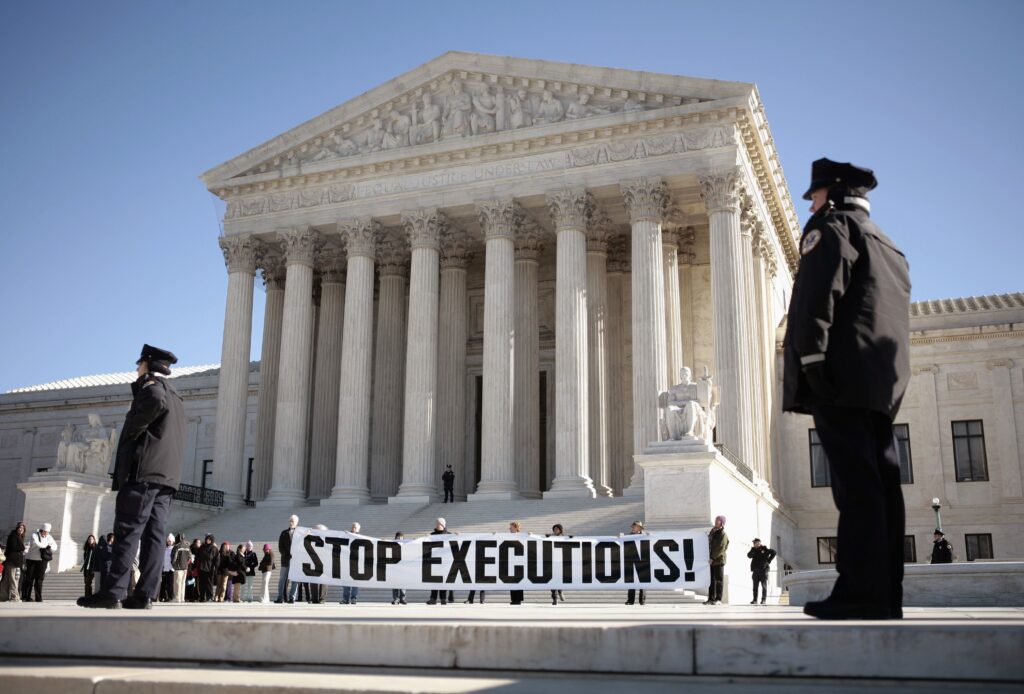
WASHINGTON (OSV News) — Despite an uptick in executions in the U.S. in 2025, opponents of the death penalty lauded decreases in new death sentences and waning public support for the practice during comments at a Dec. 3 press event announcing a new coalition called the U.S. Campaign to End the Death Penalty.
Laura Porter, the campaign’s director, said in a statement that the new coalition comes at “a critical juncture in our country’s history with the death penalty, with executions on the rise and new experimental execution methods being promoted in a handful of states despite growing opposition to the death penalty.”
“It is more important than ever that we shine a light on capital punishment’s failures and come together to show growing bipartisan support for ending executions,” Porter said.
According to data from the Death Penalty Information Center, as of Dec. 3, 44 prisoners have been executed in 11 states in the U.S. in 2025, with three more scheduled before the end of the year.
Sister Helen Prejean, a Sister of St. Joseph, who is author of “Dead Man Walking” and a member of the coalition’s advisory council, told reporters, “Simply by being a human person, we have an inalienable right to life, and you cannot entrust over to government ever to have the wisdom or the know how, or the purity of heart, to be able to carry (the death penalty) out.”
The number of executions in the U.S. nearly doubled in 2025 from the previous year, when 25 executions were carried out.
Among the first actions of his second term earlier this year, President Donald Trump signed an executive order directing the U.S. attorney general to “pursue the death penalty for all crimes of a severity demanding its use,” and to “seek the death penalty regardless of other factors for every federal capital crime” that involves the “murder of a law-enforcement officer” or a “capital crime committed by an alien illegally present in this country.”
Some states, such as Florida, have sought to follow suit, dramatically increasing their scheduled executions.
However, an October 2025 Gallup poll found that although a slim majority of Americans favor the death penalty for people convicted of murder, that number continued a steady decline over 30 years, dropping from a peak of 80% in 1994 to 52% in 2025. While statistically similar to its findings in the previous two years, the 2025 result marks the lowest in Gallup’s death penalty trend since 1972, when 50% were in favor.
“I am full of hope on this issue, despite the harshness and terribleness of what’s going on, because I know I’ve been with the people too much, and I see they get the message,” Sister Helen said.
The coalition of more than 50 organizations aims to further increase the number of Americans opposed to the death penalty, advocate for more states to end the practice, and decrease the number of new sentences.
Demetrius Minor, executive director of Conservatives Concerned, a group that opposes the death penalty on pro-life and limited government grounds, told reporters, “more and more conservatives across the country are questioning the death penalty and advocating for change.”
Minor argued there is “significant growing interest in the pro-life community to explore how the death penalty fits into their advocacy for life issues, and many are taking on the death penalty.”
“Every successful repeal of the death penalty in the last 20 years has included support from pro-life Republican legislators,” he said. “We expect much more of that in the years to come, and by working in collaboration with the U.S. campaign to end the death penalty and its partners, we can ensure that these efforts continue to be inclusive and bipartisan in the future.”
The Catholic Church’s official magisterium opposes the use of capital punishment as inconsistent with the inherent sanctity of human life, and advocates for the practice’s abolition worldwide.
The late Pope Francis revised the Catechism of the Catholic Church in 2018 to clarify the church’s teaching that capital punishment is morally “inadmissible” in the modern world and that the church works with determination for its abolishment worldwide.
In his 2020 encyclical “Fratelli Tutti,” Pope Francis addressed the moral problem of capital punishment by citing St. John Paul II, writing that his predecessor “stated clearly and firmly that the death penalty is inadequate from a moral standpoint and no longer necessary from that of penal justice.”
About a decade prior to becoming Pope Leo XIV earlier this year, then-Bishop Robert Prevost also raised his voice in support of abolishing capital punishment, writing in a March 5, 2015, post on X, then known as Twitter, “It’s time to end the death penalty.”
