
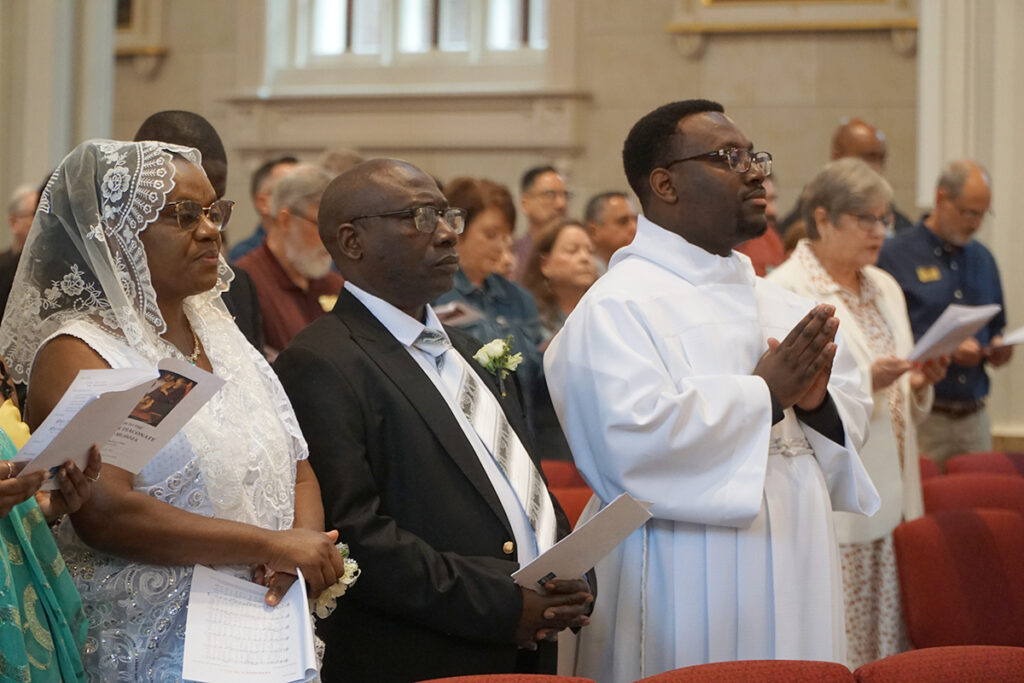
As a young boy living in the East African country of Burundi, Deacon Evrard Muhoza said many prayers asking God to keep his family safe from political violence.
A decade-plus later and more than 7,700 miles away, those prayers blossomed into a vocation to the priesthood.
Archbishop Shelton J. Fabre will ordain Deacon Muhoza a priest of the Archdiocese of Louisville on May 30 at the Cathedral of the Assumption in downtown Louisville.
As ordination day draws near, Deacon Muhoza, 27, said he is feeling a mixture of excitement and nervousness.
He is looking forward to hearing confessions and celebrating Mass, particularly the school Masses for children at St. Patrick Church, where he is assigned as an associate pastor.
Deacon Muhoza said he is also looking forward to uniting people.
“After I joined the seminary, I always reflected on that — the priest as someone who unites others as the Son of God did,” he said during a recent interview about his ordination, noting that he had an uncle who was a priest, and he admired his ability to unite people
“As my ordination draws near that’s something that I pray for — to be able to be a son of unity.”
— Deacon Evrard Muhoza
“Christ has asked us to remain united,” Deacon Muhoza said. “As my ordination draws near, that’s something that I pray for — to be able to be a son of unity.”
During the interview, Deacon Muhoza also described his journey to the priesthood, which began in his native Burundi amid major changes in his life.
“My vocation was influenced by my family’s journey to the United States,” he explained. “Growing up, I never saw myself as a priest, but around 2008, things started changing for my family.”
Deacon Muhoza arrived in Louisville in 2014 with his mother, Pascaline M. Sinzinkayo, and his four siblings. He was 15 years old. Two years earlier, his father, Severin Barumunungu, a politician, had immigrated to the United States as an asylee from Kenya, where he was living to escape political violence.
Deacon Muhoza said his father served as a representative of their province — in Rushubi, Burundi — and was running for re-election. After surviving an attempted assassination, his father moved the family to Bujumbura, the capital city. The threat of violence followed them, and his father soon fled to Kenya, located some 600 miles away, leaving the family in Bujumbura.
Deacon Muhoza explained that his father gave each child a different last name in an attempt to protect them. He chose names that tell of the goodness of God, Deacon Muhoza said. In his native Kirundi language, Muhoza means “to comfort.”
With the threat of violence still looming over his father and family, Deacon Muhoza’s mother asked him to pray for his father, assuring him, “ ‘God listens to your prayer. God listens to children,’ ” he recounted.
“Every Saturday I’d go to the shrine (of Mont Sion Gikungu) near our parish, and I’d pray for my dad with the Blessed Sacrament, praying for his safety and the safety of our family,” said Deacon Muhoza. “That experience of going to pray for his safety and then, first of all, surviving and coming here, it really deepened my faith, my love for God. It also brought me to the faith in a way that was serious.”
When the family arrived in Louisville, they became members of St. Bartholomew Church. They didn’t speak or understand English very well, but they attended Mass faithfully, he said.
As his calling to discern the priesthood grew stronger, Deacon Muhoza said he was tempted to use his limited English as an excuse not to pursue the priesthood. His mother reminded him there was a Biblical figure who had a similar problem, he said.
“Then my mom started quoting Moses in Exodus,” he recalled, laughing. “ ‘Moses was saying the same thing, telling God, ‘I don’t know what to say.’ And God said, ‘I’ll tell you what to say.’ ” After that conversation with his mother, Deacon Muhoza said he no longer had an excuse.
Thinking back on those moments in front of the Blessed Sacrament, praying for his family’s safety, finally helped him decide.
“I was just praying in silence, and I started thinking about before we came to the United States. … God listened. It hit me hard because God always listened to my prayers, but now at this point I’m not listening whenever God is speaking to me,” he said.
Telling himself that it was time to start listening, he said, “I started thinking of the priesthood and being open to the priesthood.”
Deacon Muhoza said he told Father Roy Stiles, associate pastor at St. Bartholomew at the time, that he was considering the priesthood. He confided his fears — he wasn’t confident in his English language skills, and he didn’t know anything about the archdiocese.
Father Stiles encouraged him, he said.
“He started telling me about the early bishops, Bishop Flaget. He told me about the history of the diocese. He started teaching me a few prayers in English and gave me a prayer book,” he said.
Deacon Muhoza earned a bachelor’s degree in Catholic studies at Marian University in Indianapolis and began his formation for priesthood at Bishop Simon Bruté Seminary College. He went on to attend St. Meinrad Seminary and School of Theology in southern Indiana.
Archbishop Shelton J. Fabre has appointed Deacon Muhoza to serve as parochial vicar (formerly known as associate pastor) of St. Patrick Church following his May 30 ordination. The ordination Mass will begin at 11 a.m., and all are welcome to attend.
