
One of the finest geological collections in the country could once be found in Bardstown, Ky. So said an article in the July 25, 1846, edition of The Catholic Advocate, predecessor of The Record.
The Advocate included a letter about St. Joseph’s College in Bardstown, from its president, “Edw’d M’mahon.” Among other things, the president bragged about how the college “engaged the valuable services of Rev. F. (Francis) Chambige, as Professor of Natural Sciences.” Father Chambige was back from France with “not less than three thousand Geological and Mineralogical specimens,” giving St. Joseph’s “one of the largest and most complete collections in the Union,” and significantly strengthening its science curriculum.
The collection would be housed in a sort of museum in the college’s Flaget Hall, a building that still stands (now housing the parish offices of St. Joseph Proto-Cathedral). This was during the time when people were enslaved in Kentucky, so probably some of the hard work involved in the Chambige collection was done by enslaved people (who perhaps shared Chambige’s interests — no scientist would trust such a project to disinterested help) whose names are now lost.
St. Joseph’s College did not survive the Civil War, but Father Chambige and his collection did. He became the ecclesiastical superior of the Sisters of Charity of Nazareth in 1861. Anna Blanche McGill’s 1917 book on the SCNs notes that Chambige was “proficient in chemistry, botany, geology,” and that he both educated the sisters in science and “presented to them his collection of geological and mineralogical specimens which today forms a valuable contribution to one of the academy’s best equipped departments, the Museum.”
The SCNs, who even in 1846 were awarding prizes to young women at their Nazareth Academy in botany and chemistry, acquired still more science material, increasing “the opportunities for teaching physics, geography, astronomy and the other sciences”.
Photos from the early 20th century show much science and natural history material at Nazareth. Numerous cabinets and tables hold displays of things — from birds to Kentucky ferns. A very old photo labelled “Geological Specimens” shows a sister studying some very large fossils, surrounded by even more fossils, books and a large poster on “The Pre-Adamite Earth” that illustrated ideas from the time on how volcanoes and the folding of the Earth’s crust shaped the world we now see. Presumably, at least some of that material originated with Father Chambige.
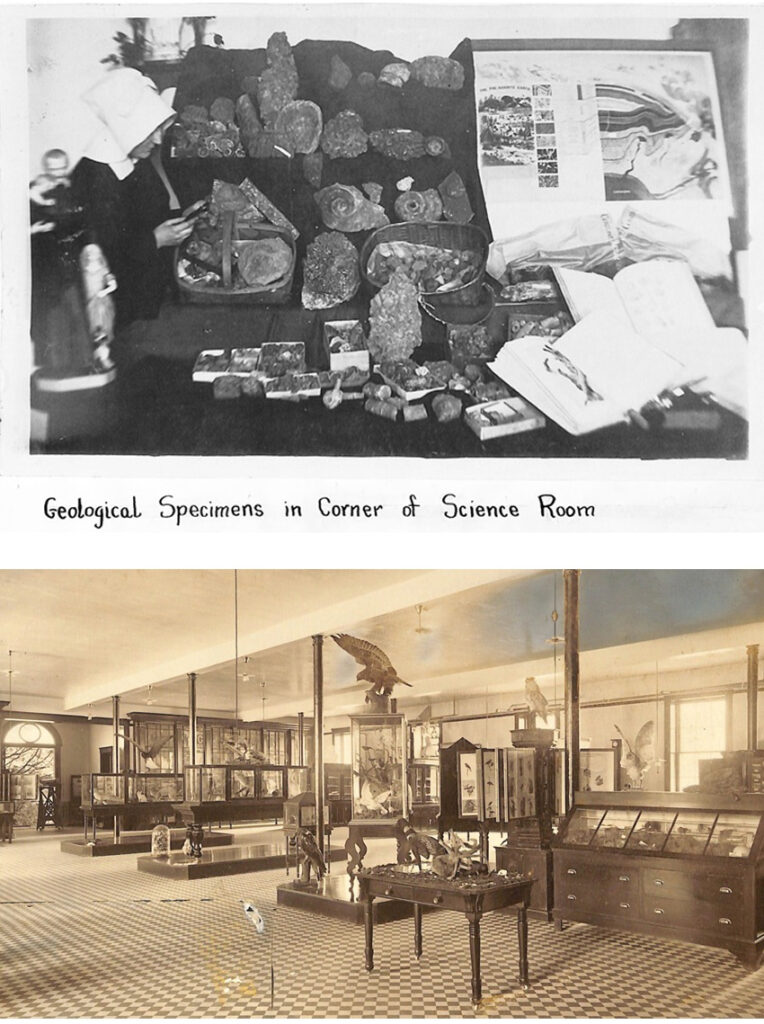
Perhaps by the turn of the 20th century, the Bardstown materials could no longer be described as among the best in the country. Nevertheless, the science material at Nazareth was impressive. What school boasts such resources today?
But things do not last. Nazareth Academy closed 60 years ago. It survives in the form of Spalding University (which itself began with a cadre of SCN sister-scientists, as I discussed in this column in April 2023). The science material of the Bardstown-Nazareth museums is gone, like Kentucky’s recently closed Hummel and Rauch planetariums (Hummel was once one of the largest and most sophisticated in the country).
What became of all that science material, including Father Chambige’s collection? That is unclear. If records were made, they were apparently lost.
Perhaps some of the material was donated to the predecessor of the Kentucky Science Center in Louisville. I hope so. The science center recently donated all of its geological specimens to Bellarmine University.
Thus, once again, a Catholic institution in Kentucky houses an impressive collection of “Geological and Mineralogical specimens!” May it drive a flowering of science education, like the Bardstown material once did. And if, by Providence, there is some Chambige material in the Bellarmine collection, that would be so cool!
